
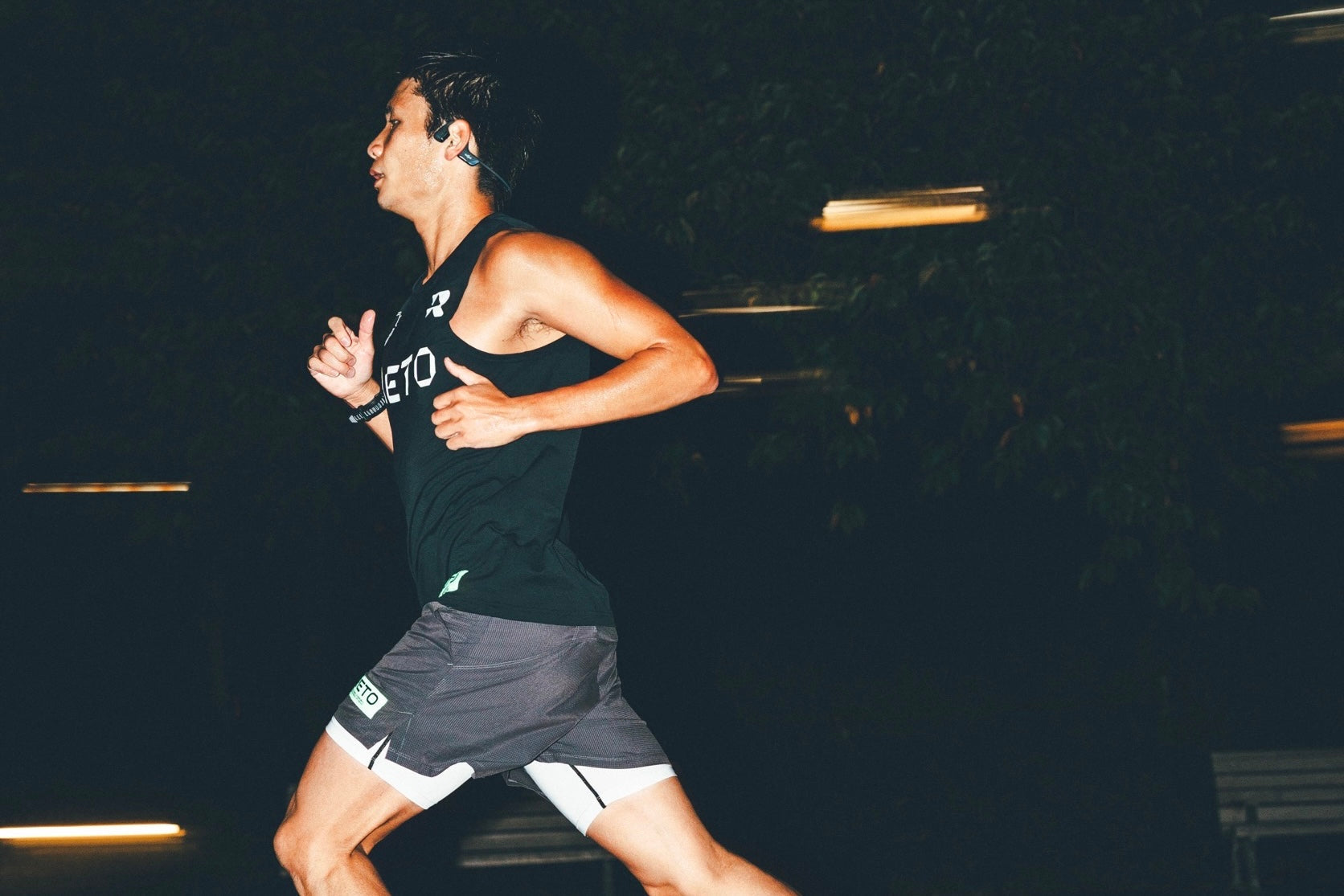
I want to see more of the scenery above
RRC member interview
Text: Shun Sato

14th Cool Team A1 (Goal: Full marathon under 3 hours) MVP Akihiro Nakamura
A good feeling
This was my third time participating in the Yokohama Marathon.
The first time was 3 hours 45 minutes, the second time 3 hours 34 minutes, and this time I was able to improve my personal best (3 hours 18 minutes), so I was happy to see my own growth. I was able to achieve my personal best thanks to the speed training I did in official training and Hamaren. I was originally an endurance racer and was good at long distances, so I wasn't particularly fast. But as I continued to practice, I could feel my speed improving, and that gave me confidence.

The effects of the treadmill
My running distance has also increased. At the time of the Kyoto Marathon in February, I was running around 150 kilometers a month, but I was told that distance was key to improving my time, so now I'm running just under 300 kilometers. As a personal trainer, I only have time to run in the morning or evening. My job also puts me at the gym a lot, so I run on the treadmill. I probably run about 100 kilometers a month on the treadmill. I try to run about 10 to 15 seconds faster than my regular pace, covering about 10 kilometers. My current goal is to run a sub-3 marathon, so I run at a 4-minute kilometer pace to get my legs used to the speed, starting at 4 minutes 30 seconds per kilometer and building up to 3 minutes 50 seconds. However, because I feel like I'm being pushed around on the treadmill, I feel a bit uneasy when I run on the road afterwards. Because I have to push myself forward, I don't feel like I'm going as fast as I'd like. Still, it's necessary to get a sense of speed, and it's become an essential practice for me.

Speed margin
I do strength training to build a body that can withstand speed and to maintain my running form as much as possible. To do this, I need to understand my muscles and my body. Knowing my body well is essential to running fast, and it's also important for preventing injuries. Thanks to this, I've never had an injury and have been able to train continuously, which I believe has led to improved running ability.

Challenges from age 30
When I turned 30, I decided to try something new and started running marathons. A year later, I participated in the Shonan International Marathon for the first time. I thought I could do it, but after about 4 hours and 15 minutes, my knees started to hurt and both my legs cramped, so I thought I'd give up on marathons. However, as I met various people, I had more opportunities to run and participated in races, and I gradually got faster, so I became addicted to marathons.
I had no experience in track and field, and played basketball in middle and high school. After that, I studied anatomy at a vocational school and joined the swimming club. I learned swimming and started working at a sports club to put that knowledge to good use. While teaching swimming and training, I learned about personal trainers, and now I work in that field. Many of my clients are elderly people who come to me for help with leg and shoulder pain, or to maintain their health and improve their posture, and I teach swimming at sports clubs and as a kids' personal trainer.

A view from above that I have yet to see
I was introduced to RETO by Cherry (Tetsuya Sakurai) and applied. I met Cherry about two years ago at the Nippon Television Running Club, and I've participated in FTK several times. When I participate in RETO training sessions, I can see myself getting faster and faster, and I can really feel my growth. Running is so much fun.
My current goal is to run under three hours, but I would like to see a view even higher someday. I would like to keep working hard little by little until I can reach that level.


%20MVP%20Akihiro%20Nakamura%0A%0A%20A%20good%20feeling%0A%0A%20This%20was%20my%20third%20time%20participating%20in%20the%20Yokohama%20Marath...)